

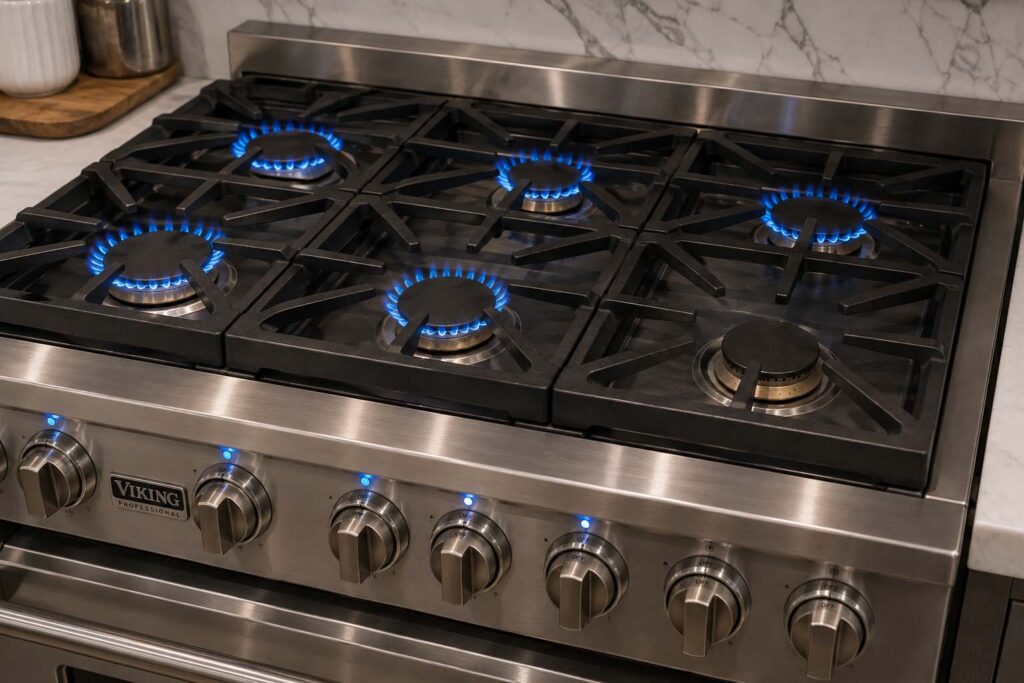
A Viking stove burner not working comes down to one diagnostic question: is it one burner or every burner? One dead burner usually means a clogged port, a wet or failed igniter, or a loose connection. All burners out points to power loss, gas supply, or a failed control module.
That single split — one versus all — tells a Viking technician where to look before any tool comes out. It saves time, and it often saves you a service call. Viking Appliance Repair Pros services Viking gas, dual-fuel, and induction ranges across Seattle, San Jose, and Denver, and the same failure patterns show up again and again. This guide walks the checks in order, safety first, so you know whether it is a two-minute fix or a call to a pro.
First: One Burner or All of Them?
The fastest way to diagnose a Viking burner problem is to test every burner, one at a time.
- One burner out, the rest fine — the problem is local to that burner: its igniter, port, or wiring.
- All burners out — the problem is shared: gas supply, power to the range, or the control board.
- Burners light but flame is weak or yellow — a gas-flow or port-cleaning issue, not a dead burner.
- Burner clicks but never lights — an igniter or spark-module issue, common after spills.
Sort your symptom into one of those buckets first. Everything below follows from it.
⚠️ Safety First — Read Before You Touch Anything
Shut off the gas or unplug the range before inspecting any burner. If you smell gas at any point, do not flip switches or light a flame. Turn off the gas supply valve, leave the door open, get everyone out, and call your gas company from outside. A persistent gas smell is an emergency, not a repair.
Never bypass a Viking safety valve or wire around a failed igniter. Those parts exist to stop unburned gas from filling your kitchen.
Quick DIY Checks (Safety-First, In Order)
Work through these before assuming a part has failed. Most take under five minutes.
- Confirm the gas is on. Check that the main supply valve behind or under the range is open, and that other gas appliances still work.
- Cut the power and let it reset. For dual-fuel and induction models, unplug the range or trip its breaker for two minutes, then restore power. A locked-up control board often clears.
- Clean the burner head and ports. Lift off the grate, burner cap, and burner base. Clear every port with a straightened paperclip — not a toothpick, which can snap off inside.
- Dry everything fully. Spills and cleaning water are the top reason a Viking burner clicks but will not light. Let parts air-dry or wait 24 hours.
- Reseat the burner cap square. A cap sitting crooked will misfire or not light at all. Set it flat and centered.
- Listen for the clicking spark. Steady clicks mean the igniter is trying. No click on any burner points to a shared spark-module or power problem.
If the burner works after cleaning and drying, you are done. If it still fails, move to part-level causes.
Likely Part-Level Causes
When One Burner Is Out
- Failed spark igniter (electrode). The most common single-burner cause. It clicks weakly, unevenly, or not at all. Igniters wear out and crack over time.
- Clogged or corroded burner ports. Blocks gas at that one burner even when the igniter sparks fine.
- Loose or burnt igniter wire. A single disconnected wire kills one burner while the module still feeds the others.
- Worn burner switch (sealed-burner models). The knob turns but the switch no longer completes the circuit.
When All Burners Are Out
- No power to the range. A tripped breaker or unplugged cord stops the spark module on gas models and everything on induction.
- Interrupted gas supply. A closed valve, or work done on the gas line, cuts every burner at once.
- Failed spark module. The shared igniter control feeds all burners; when it dies, none will light.
- Control board fault (dual-fuel / induction). The board that manages burner power has failed and needs testing or replacement.
Induction ranges add their own signals — an error code, a cooktop that will not detect pans, or a fan that runs constantly. Those point to the control board or a cooling fault rather than a burner cap.
When to Call a Seattle, San Jose, or Denver Pro
Some jobs are safe to try. Others are not worth the risk on a Viking range.
Call a professional when:
- You smell gas at any time — stop and call the gas company first.
- Cleaning and drying did not fix a burner that clicks but won’t light.
- No burner lights and power and gas are both confirmed on.
- An induction cooktop shows an error code or will not heat.
- You would need to open the range body or touch the gas manifold or control board.
Viking uses sealed burners, spark modules, and control boards that differ from mass-market ranges. A technician who works on Viking daily carries the right igniters and can test a board instead of guessing. Viking Appliance Repair Pros offers same-day and next-day service across the greater Seattle, San Jose, and Denver metros.
Repair Cost: What to Expect
All figures below are general estimates. Actual pricing depends on your model, parts, and market. Ask for a written quote before work begins.
| Problem | Typical part-level fix | Estimated range* |
|---|---|---|
| One burner won’t light after cleaning | Spark igniter / electrode | $130–$260 |
| Burner clicks, no spark on any burner | Spark module | $180–$350 |
| Weak or yellow flame | Port cleaning / burner head | $120–$200 |
| Faulty burner switch | Sealed-burner switch | $150–$300 |
| No burners at all (control fault) | Control board test / replace | $300–$650 |
*General estimates only — not a quote.
Repair vs. replace math: a single igniter or switch repair is almost always worth it on a Viking range, which is built to run for decades. Think harder only when a control board on an older dual-fuel or induction model approaches roughly a third to half the price of a comparable new range. For most single-burner faults, repair is the clear call.
Serving Greater Seattle, San Jose & Denver — Call Today
If your Viking burner still won’t light after the checks above, skip the guesswork. Viking Appliance Repair Pros diagnoses burner, igniter, and control-board faults on every Viking range, cooktop, and dual-fuel model. Same-day and next-day slots are available across all three metros.
Book on our Viking range repair page, request a quote, or call (855) 666-9755 to speak with a Viking specialist now.
Frequently Asked Questions
Why is only one burner on my Viking stove not working?
One dead burner on an otherwise working Viking range almost always means a local fault at that burner. The usual causes are a clogged port, a wet or cracked spark igniter, or a loose igniter wire. Clean and fully dry the burner cap and ports first. If it still clicks without lighting, the igniter or switch likely needs replacing.
Why are all the burners on my Viking range not working at once?
All burners failing together points to a shared cause rather than a single part. Check that the range has power and that the gas supply valve is open, since both feed every burner. If power and gas are confirmed, the spark module or control board has likely failed. That test belongs to a technician, not a DIY fix.
Can I fix a Viking burner that won’t light myself?
Cleaning and drying a Viking burner is safe to do yourself and fixes many no-light problems. Lift off the cap, clear each port with a paperclip, dry everything fully, and reseat the cap square. Stop there if it still fails. Replacing igniters, switches, or boards, or any work near the gas line, should be left to a Viking professional.
Why does my Viking burner click but not light?
A burner that clicks but won’t light usually has a wet or dirty igniter, most often after a spill or cleaning. Moisture stops the spark from catching the gas. Turn the burner off, dry the cap and ports completely, and wait until fully dry before trying again. If steady clicking still produces no flame, the igniter or spark module needs service.
How much does it cost to fix a Viking stove burner?
Fixing a single Viking burner typically runs a general estimate of $130 to $260 for an igniter, or $150 to $300 for a burner switch. A shared spark module or control-board fault costs more. These are estimates only — your model, parts, and market set the real price, so ask for a written quote before any work begins.