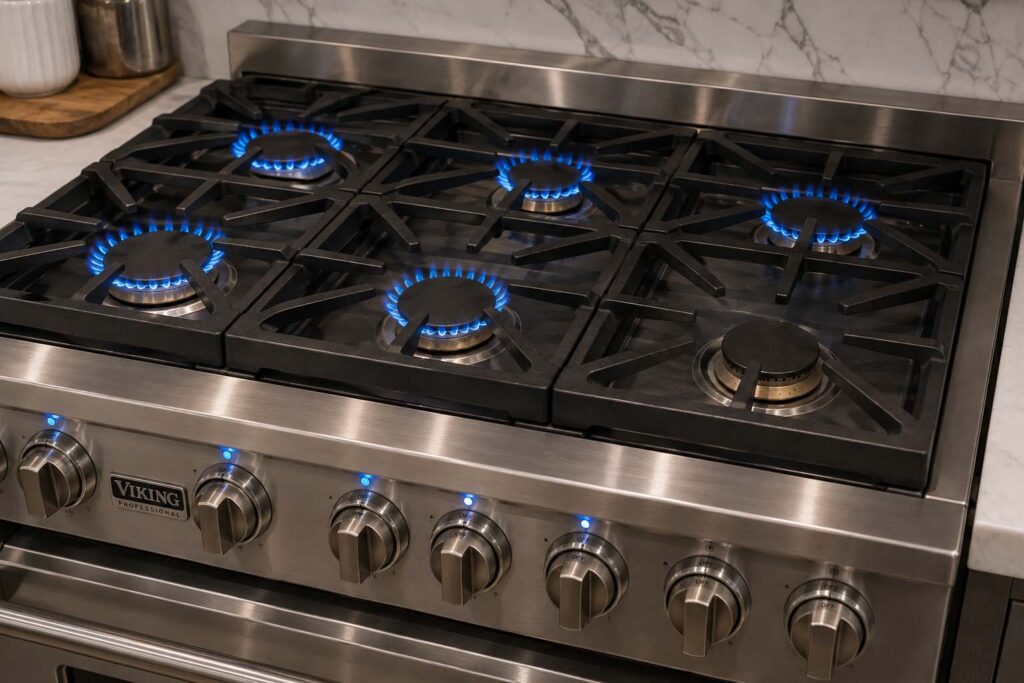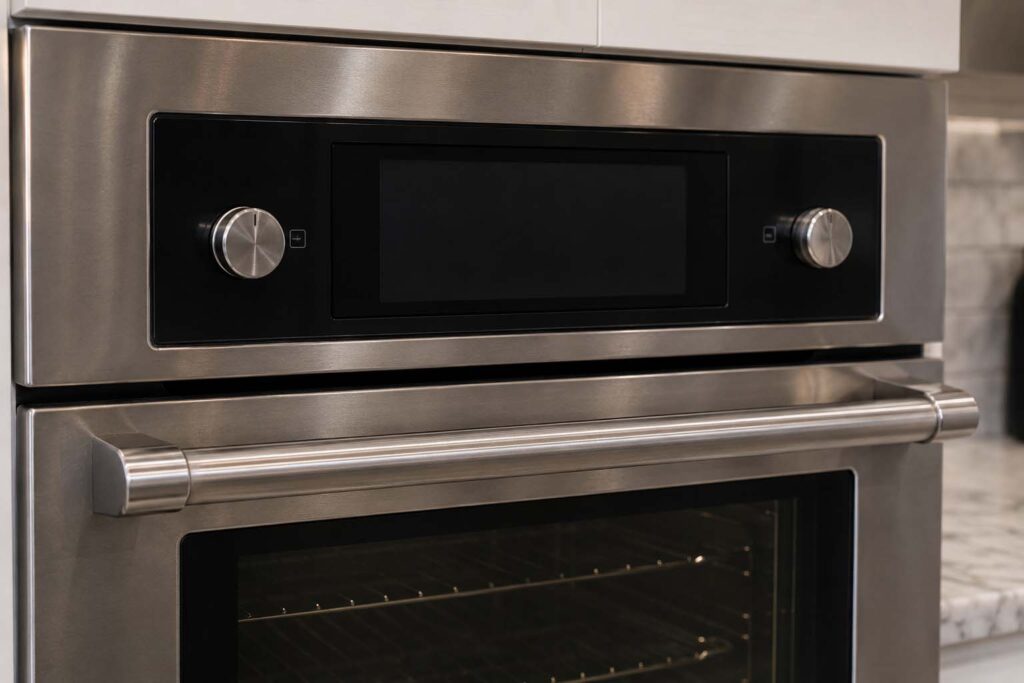


A Viking oven not heating to temperature usually points to a weak bake igniter, a failed heating element, or a drifting temperature sensor. Gas models lose heat when the igniter cannot open the safety valve. Electric models fail at the bake element or the sensor. Most fixes are part-level and predictable.
Your Viking range is built to hold precise heat, so a slow or cool oven stands out fast. Maybe the display reads 375°F but your roast never browns. Maybe preheat drags on for 30 minutes. These are common, fixable faults. This guide walks the symptoms, the safe checks you can do yourself, the parts that usually fail, and the point where a certified technician should take over.
⚠️ Safety first: Before any hands-on check, turn the oven off and unplug it, or shut off the gas at the shutoff valve. Let a hot oven cool fully. If you smell gas, stop, leave the home, and call your gas utility before doing anything else.
Is this your Viking oven?
You are in the right place if one or more of these sounds familiar. Match your symptom to narrow the cause.
- The oven turns on but never reaches the set temperature.
- Preheat takes far longer than the usual 10 to 15 minutes.
- Food cooks unevenly, or the top browns while the inside stays raw.
- The broiler works but the bake mode stays cool.
- A gas oven clicks or glows but produces little heat.
These patterns each point toward a different part. A cool bake mode with a working broiler often means a bake element or igniter. Long preheat with eventual heat usually means a weak igniter or a lazy element. Wrong readings across the board point at the sensor or calibration.
Quick DIY checks before you call
Start with the safe, no-tools checks below. Work in order. Stop at the first one that fixes the problem.
- Confirm the mode and settings. Rule out a bumped Sabbath mode, a delay-start timer, or a demo mode. Do a full reset by switching the oven off at the breaker for two minutes, then back on.
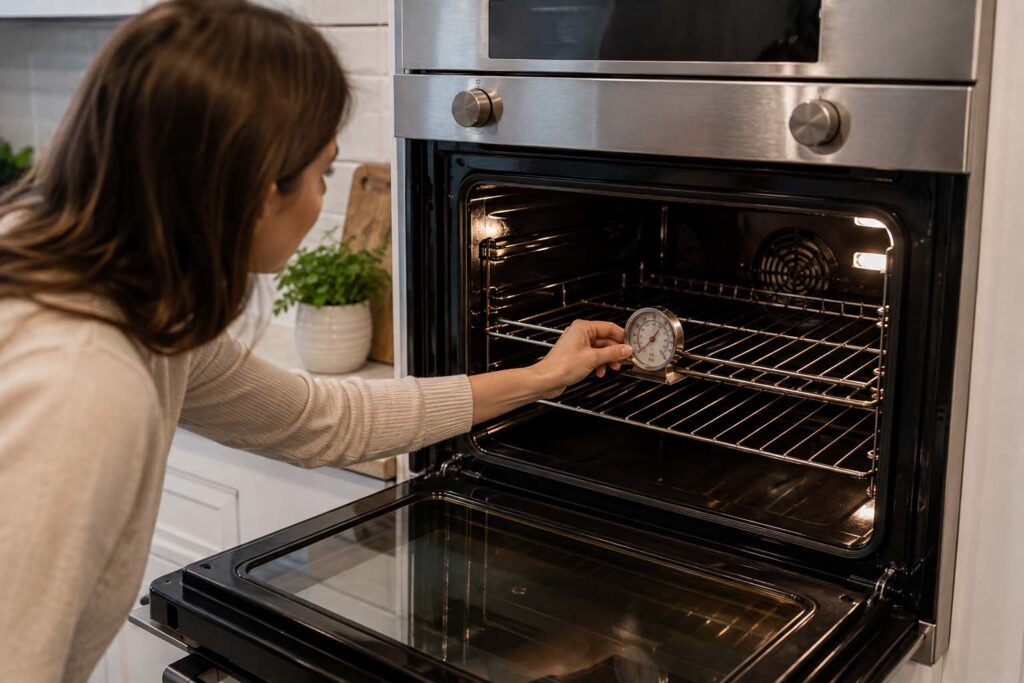
- Test real temperature. Place an oven-safe thermometer on the center rack. Set the oven to 350°F and wait 20 minutes. A gap of more than 25°F confirms a heating or sensor fault.
- Look at the bake element (electric). With the oven cool and unplugged, check the lower element. If you see blisters, breaks, or a bright spot, the element has failed.
- Watch the igniter (gas). With the room dim and the oven cool, set bake and watch the igniter through the floor vents. A healthy igniter glows bright orange and lights the gas within 90 seconds. A weak dull-red glow that never lights means a failing igniter.
- Clean the door seal. A torn or crushed gasket lets heat escape. Run your hand around the seal for gaps once the oven is cold.
Stop here if: the oven is gas and you smell gas, you see scorched wiring, or the problem returns after these checks. Wiring, gas valves, and control boards are technician work.
The likely causes inside your Viking oven
When the quick checks do not solve it, the fault is almost always one of these parts. Here is what each does and how it fails.
Weak or failed bake igniter (gas models)
The igniter is the most common reason a Viking gas oven will not heat to temperature. It has two jobs: glow hot, and draw enough current to open the safety gas valve. As it ages it still glows but pulls less current, so the valve never fully opens and the oven runs cool. A weak igniter is the number-one no-heat call on gas ranges and is a straightforward replacement.
Burned-out bake element (electric models)
On electric Viking ovens, the bake element is the lower heating coil. When it burns through, the broiler may still work but bake mode stays cold. Visible damage confirms it. Elements are a common wear part and are replaced as a unit.
Faulty oven temperature sensor
The sensor, sometimes called an RTD, tells the control board the exact cavity temperature. When it drifts out of spec, the board reads the oven as hotter than it is and cuts heat early. A technician tests its resistance against a chart, around 1080 ohms at room temperature for many models, to confirm the fault.
Calibration drift
Viking ovens can be calibrated a set number of degrees up or down. Over years, or after a control reset, calibration can slip so the oven runs cool even with good parts. A technician can re-calibrate to match a verified thermometer reading.
Control board or relay failure
The electronic control board switches the element or gas valve on and off. A failed relay on the board can leave the oven underpowered or cold. Board faults are less common than igniters or elements but do happen, especially after a power surge.
Convection fan or element
On convection models, a stalled fan or a failed convection element can leave food undercooked in convection modes while standard bake looks fine. This narrows the repair to the convection system.
When to call a Viking technician
Some of this is safe DIY. Much of it is not. Call a certified Viking technician when any of these apply.
- The oven is gas and you smell gas at any point.
- You see burned wiring, scorch marks, or melted connectors.
- The igniter glows but never lights, or the element shows no damage yet still will not heat.
- The temperature is off after a reset and re-calibration.
- The problem comes back after basic fixes.
Viking ovens use brand-specific parts and control logic. A factory-trained tech carries the correct igniter, element, and sensor, tests with a meter, and calibrates against a verified reading. That protects your warranty and your safety. Our technicians at Viking Appliance Repair Pros diagnose first and give a full quote before any work begins.
What Viking oven heating repairs typically cost
The figures below are general industry estimates for parts plus labor. Your final price depends on model, part, and local rates. We always quote the full cost after diagnosis, before we start.
| Failed part | What it does | Typical repair range* |
|---|---|---|
| Bake igniter (gas) | Lights the gas safety valve | $180 – $340 |
| Bake element (electric) | Heats the oven cavity | $170 – $320 |
| Temperature sensor / RTD | Reports cavity temp to board | $160 – $300 |
| Control board / relay | Switches heat on and off | $300 – $600 |
| Recalibration only | Corrects a cool-running oven | $120 – $220 |
*General estimates, not a quote. Diagnostic fees are often credited toward the repair.
Repair or replace?
A single igniter, element, or sensor is worth fixing on almost any Viking oven. These are premium appliances often priced well above $3,000 new, so a $200 to $350 part-level repair is easy math. Consider replacement only when a costly control board fails on a unit already past 12 to 15 years old and showing other faults. For a deeper price breakdown, see our guide to Viking oven repair cost.
Serving Seattle, San Jose and the Denver metro
If your Viking oven still will not heat to temperature, we can help. Viking Appliance Repair Pros offers certified, same-day Viking oven service across Seattle, WA, San Jose, CA, and the Denver metro area from Centennial.
Call now: (855) 666-9755 for a diagnosis and an upfront quote, or book Viking oven repair online. If your oven reaches heat but drifts once hot, read our related guide on a Viking oven not keeping temperature.
Frequently asked questions
Why is my Viking oven not reaching the set temperature?
The most common causes are a weak bake igniter on gas models, a burned-out bake element on electric models, or a temperature sensor that has drifted out of range. Each makes the oven run cool or slow. A verified thermometer test on the center rack confirms the gap, and the failed part is then replaced or recalibrated.
How do I know if my oven temperature sensor is bad?
A bad sensor makes the oven read hotter than it is, so the control cuts heat early and food undercooks. A technician tests the sensor’s resistance against the model’s chart, often near 1080 ohms at room temperature. A reading far outside spec confirms the fault. The sensor is then swapped, which usually restores accurate heating.
Why does my oven heat but not get hot enough?
An oven that heats yet never gets hot enough usually has a weak igniter, a partially failed element, or calibration drift. A worn gas igniter glows but cannot fully open the safety valve, so the burner runs low. On electric models, an aging element produces less heat. A technician tests each to pinpoint the weak link.
Can I recalibrate my Viking oven temperature?
Yes, many Viking ovens allow calibration a set number of degrees up or down through the control panel. First place an oven thermometer on the center rack and compare it to the set temperature after a full preheat. If the gap is small and steady, adjust calibration to match. A large or erratic gap points to a failed part instead.
How much does it cost to fix a Viking oven that won’t heat properly?
General industry estimates run about $180 to $340 for a gas igniter, $170 to $320 for an electric bake element, and $160 to $300 for a temperature sensor, including parts and labor. A control board runs higher. These are estimates, not quotes. We diagnose first and give a full upfront price before any work begins.
Is it safe to use an oven that isn’t heating correctly?
Stop using a gas oven that will not heat if you ever smell gas, since unburned gas is a hazard. An electric oven that only runs cool is usually safe to switch off and leave until repair. Never bypass a safety valve or run an oven with scorched wiring. When in doubt, unplug it and call a certified technician.