


A Viking freezer that isn’t freezing usually has frost-blocked evaporator coils, a failed defrost component, dirty condenser coils, or a worn door gasket. A freezer that’s over-freezing points to a faulty thermostat, temperature sensor, or air damper. Check the setpoint and airflow first; heavy frost and sealed-system faults need a technician.
This guide walks through both problems symptom by symptom: what you can safely check yourself, which parts fail most often on Viking 5 Series and 7 Series refrigeration, and what repairs cost. Viking Appliance Repair Pros services Viking refrigeration in Seattle, San Jose, and the Denver metro, including Centennial, CO. If your refrigerator side is also warm, start with our Viking refrigerator not cooling guide — the two faults often share a cause.
Start with the setpoint, power, and airflow
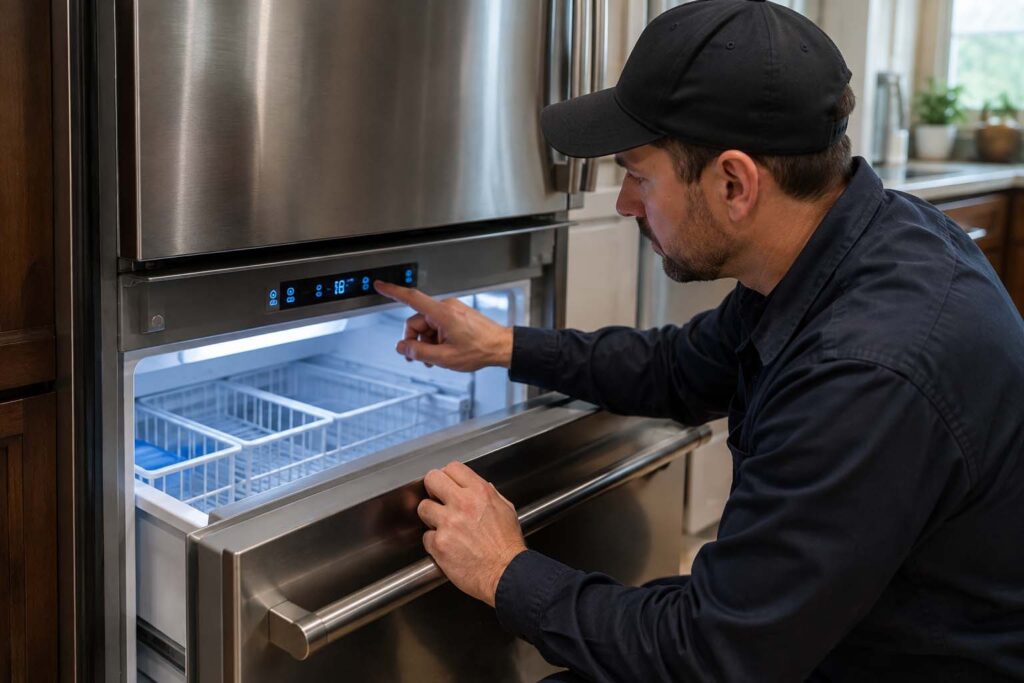
Before assuming a part has failed, rule out the simple stuff. Confirm the freezer is set to 0°F — the USDA states food kept constantly frozen at 0°F stays safe indefinitely. A setpoint bumped to 5°F or 10°F is enough to soften ice cream and frost over packages.
Next, check the basics. A door left ajar overnight, a fresh load of warm groceries, or vents blocked by overpacked shelves will all drag temperatures up for hours. Give the unit 24 hours at 0°F with clear vents before judging it.
Why is my freezer running but not cold?
A freezer that runs but won’t get cold is moving air across coils that can’t absorb heat — usually because they’re buried in frost, caked in dust, or low on refrigerant. The compressor hum tells you the unit has power, not that cooling is working. The sections below cover each cause in the order we find them on service calls.
Frost buildup on the evaporator: the most common cause
On our service calls for this symptom, a frosted-over evaporator is the cause we find most often. The evaporator coil sits behind the freezer’s rear or bottom panel. When the automatic defrost system fails, frost grows over the coil until air can’t pass through it — the freezer runs constantly but drifts warmer every day.
Telltale signs: a sheet of frost or ice on the interior back wall, a fan that whirs or chirps against ice, and a freezer that works again for a few days after being emptied and unplugged. A frost layer thicker than about 1/4 inch on the panel or coil points to a defrost failure, not normal operation.
Three parts run the defrost cycle, and any of them can fail: the defrost heater, the defrost thermostat (bi-metal), and the control board that times the cycle. A manual defrost — food out, power off, door open for 24 hours — is a diagnostic, not a fix. If the frost returns within a week or two, one of those three parts needs replacement.
Safety: unplug the unit before removing any interior panel, and never chip ice off the coil with a knife or screwdriver. One puncture of the evaporator releases the refrigerant charge and turns a modest repair into sealed-system work. Melting frost also has to drain somewhere — if you see water pooling under the unit afterward, our Viking refrigerator leaking water guide covers the drain path.
Dirty condenser coils make the whole system run warm
The condenser dumps the heat your freezer removes. On Viking built-in models the condenser and compressor sit behind the top grille, where they pull in kitchen dust, pet hair, and cooking grease. Our technicians recommend cleaning the condenser every 3 to 6 months — sooner in homes with pets.
When the coil mats over, refrigerant can’t shed heat, and freezer temperature climbs even though everything is “running.” The fix costs nothing: cut power, open the grille, and clean the coil with a vacuum and soft brush. If temperatures don’t recover within 24 hours of a coil cleaning, the problem is elsewhere.
Door gaskets and air leaks
A worn or torn gasket lets warm, humid room air seep in around the door. The freezer loses capacity and gains frost at the same time — which is why a bad gasket can mimic both “not freezing” and “over-frosting” complaints.
Run the dollar-bill test: close the door on a bill and pull. Repeat at several points around the door. If it slides out with no resistance anywhere, the gasket isn’t sealing there. Look also for cracks, hardened corners, or a door that has dropped out of alignment on its hinges.
A gasket replacement on a Viking freezer door is usually a one-visit fix, and it’s one of the cheapest repairs on the whole unit. It’s worth doing early — a leaking gasket forces the compressor to run far longer than designed.
Evaporator fan, compressor, and sealed-system faults
If the coil is clean, frost-free, and sealed behind a good gasket, the remaining suspects are mechanical. The evaporator fan moves cold air off the coil; when it fails, the coil freezes solid while the compartment stays warm. Listen for silence, grinding, or clicking from behind the freezer’s interior panel.
Compressor and sealed-system problems are the serious end of the scale. Signs include a compressor that’s hot and silent, rapid clicking as it tries and fails to start, or a unit that cools weakly no matter what you’ve cleaned or defrosted. Federal law requires EPA Section 608 certification to handle refrigerant, so sealed-system diagnosis and repair is professional-only work.
There is no safe DIY path here — book a diagnostic through our Viking refrigerator repair service and get the fault confirmed before spending anything on parts.
Freezer over-freezing or too cold? Check these three parts
The opposite complaint — rock-hard ice cream, frost on every package, or freezer burn within days — traces to three components. First, the thermostat or temperature sensor: when it drifts out of calibration, it reads the compartment as warmer than it is and never tells the compressor to stop. A freezer that sits well below 0°F on an independent thermometer, at a normal setpoint, has a control fault, not a settings problem.
Second, the air damper. On bottom-freezer and French-door models, a damper meters cold freezer air into the refrigerator. Stuck open, it over-chills one compartment and can freeze produce in the fridge; stuck closed, it traps all the cold below. Third, the control board itself — if it stops cycling the compressor, temperatures fall until something (often the ice maker) jams with frost. If ice production has also stopped, see our Viking ice maker troubleshooting guide.
One distinction saves a lot of worry: fluffy frost on food usually means humid air is getting in through door openings or a gasket leak. Solid ice sheets on walls or the floor of the compartment mean a defrost or control fault. The first is a habit fix; the second is a repair.
Repair costs and when to call a pro
Freezer cooling repairs span a wide range because the causes do. Per our Viking refrigerator repair cost guide, fan motor and defrost-component repairs typically land between $175 and $550, while sealed-system work starts around $1,000. Gasket and thermostat replacements usually fall at the lower end of that range.
Call a professional when frost returns after a full manual defrost, when the compressor clicks or won’t start, when both compartments are warm, or whenever refrigerant is in question. On a built-in Viking that costs $7,000 to $15,000 to replace, even a four-figure sealed-system repair is usually the sound financial call — a point our cost guide works through in detail.
Viking Appliance Repair Pros provides a written quote after diagnosis and before any work begins, so you decide with the real number in front of you.
Frequently asked questions
How do I reset a Viking freezer?
Most Viking freezers reset by cutting power for about 5 minutes — unplug the unit or switch off its breaker, then restore power and reset the temperature to 0°F. There is no universal reset button across Viking refrigeration models. A reset clears control glitches, but if the freezer warms up again within a day, a component has failed and needs diagnosis.
Can the freezer stop working while the refrigerator still works?
Yes — on many Viking bottom-freezer models the freezer holds the evaporator and fan, so a frosted coil, failed fan, or stuck damper can warm one compartment before the other. A cold fridge with a warm freezer most often points to frost buildup or a fan fault. If both compartments are warm, suspect the condenser, compressor, or control board instead.
How do I know if my freezer’s compressor is bad?
A failing compressor is usually hot to the touch and either silent or clicking every few minutes as it tries to start. The freezer runs but never reaches 0°F, even with clean coils and no frost. Only an EPA-certified technician can confirm it, because testing and repair involve the sealed refrigerant system. Get a diagnosis before pricing parts — start relays mimic compressor failure at a fraction of the cost.
Why is my Viking freezer too cold or covered in frost?
A freezer that’s too cold usually has a miscalibrated thermostat or temperature sensor, a stuck air damper, or a control board that won’t cycle the compressor off. Frost on food alone points instead to humid air entering through door openings or a worn gasket. Verify with an independent appliance thermometer: below about -5°F at a normal setpoint means a control fault.
Is food safe to refreeze after a freezer failure?
Food is safe to refreeze if it still contains ice crystals or has stayed at 40°F or below, according to the USDA. Discard anything above 40°F for more than 2 hours — especially meat, seafood, and dairy. Quality may drop after refreezing, but safety follows the temperature rule, not appearance or smell.
Get your Viking freezer back to 0°F
Work the list in order: setpoint and airflow, frost, condenser coil, gasket, then fan and compressor. The first three you can check yourself in under an hour; the rest deserve trained hands and Viking-specific parts.
If the freezer still isn’t holding temperature, book a diagnostic with our Viking freezer repair service or request a quote online — you’ll get a written price after diagnosis, before any work begins. We serve Seattle, San Jose, and the Denver metro, including Centennial. Call (855) 666-9755.