


A refrigerator ice maker that stops working usually has one of five causes: the ice maker is switched off or its arm is blocked, the fill tube has frozen, the water filter is clogged, the inlet valve isn’t opening, or the ice maker module itself has failed. The first three are owner checks; the last two need a technician.
Ice makers fail more often than any other part of a refrigerator’s water system because they combine water, freezing temperatures, and moving parts in one small assembly. The good news: the causes sort cleanly by symptom, so you can usually tell what’s wrong before anyone opens a panel. This guide covers the checks in order, Viking-specific behavior worth knowing, and the point where DIY stops. Viking Appliance Repair Pros repairs Viking refrigeration and ice makers in Seattle, San Jose, and Denver — book a visit if the checks below don’t restore ice.
Start with the two-minute checks
Before touching a tool, rule out the switches. Every ice maker has a shutoff — a wire feeler arm that stops production when raised, or a paddle and power switch on other designs. A bag of frozen vegetables pushed against the arm reads as “bin full” and shuts production down; so does an arm accidentally lifted while unloading ice.
Confirm the freezer is actually at temperature: ice makers stop producing when the freezer runs warmer than about 10°F, well before food shows it. Check that the household shutoff valve feeding the refrigerator — usually under the sink or behind the unit — is fully open. And if anything was recently unplugged or a breaker tripped, give the system 24 hours; ice makers cycle slowly, and a healthy one produces roughly a tray of cubes every 90 minutes to 2 hours.
No ice at all: the water path is blocked
When the ice maker cycles but the mold stays empty, water isn’t arriving. Work down the path in order.
The water filter comes first. A filter past its service life restricts flow enough to starve the ice maker even while the dispenser still trickles. If it’s been more than 6 months, replace it — and if ice production was also slowing before it stopped, the filter is the leading suspect.
The fill tube comes second. The small tube that delivers water into the mold can freeze solid, especially after a door was left ajar or freezer temperature swung. A frozen fill tube shows as a visible ice plug where the tube meets the ice maker.
The water inlet valve comes third. It’s the electrically operated valve at the back of the unit that opens on each fill cycle; when its solenoid fails or its screen clogs with sediment, no water passes at all. Valve testing and replacement sit on the pressurized supply line — that’s technician work, not a weekend project.
Ice, but wrong: small, hollow, or bad-tasting cubes
Partial symptoms narrow the diagnosis further. Small or hollow cubes mean low water flow — a tired filter, low household pressure, or a partially clogged valve screen. Cloudy or bad-tasting ice points at the filter or a long-idle bin; dump the bin, replace the filter, and let two full cycles pass. Ice that fuses into a single clump means cubes are melting slightly and refreezing — a freezer temperature problem or a door-seal problem, not an ice maker problem.
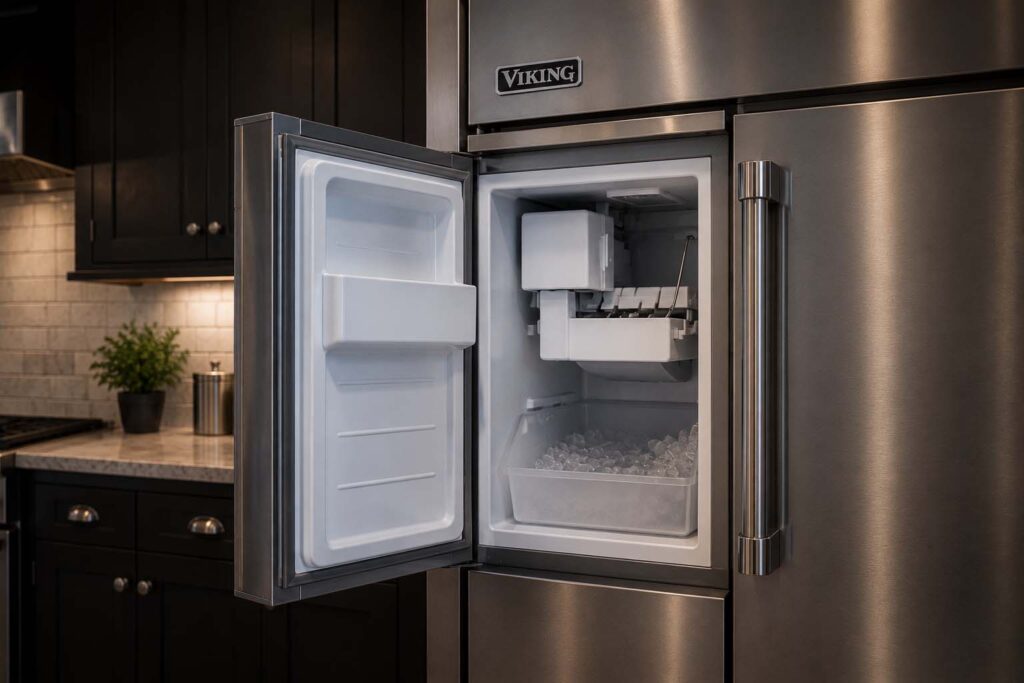
One Viking-specific note: on built-in units the ice maker and its fill components sit behind interior panels, and access is tighter than on freestanding models. If a symptom points behind the panels, forcing them isn’t worth the broken clips — panel removal on a built-in is routine for a technician with the right access sequence.
The ice maker module: when the machine itself is done
If water reaches the unit, temperatures are right, and production still won’t resume, the ice maker assembly or its control has failed. The module runs the harvest cycle — the heater that releases cubes, the motor that sweeps them out, and the thermostat that decides when. Any one of them failing stops the whole sequence.
Ice maker assemblies are replaced as a unit in most cases, and on a Viking it’s a single-visit repair once the correct OEM assembly is on the truck. Fault-by-fault pricing sits in our Viking refrigerator repair cost guide; ice maker work lands in the middle of the refrigerator range — far below sealed-system repairs. If the refrigerator has also lost cooling performance, diagnose that first: our guide to a Viking refrigerator that isn’t cooling explains why the ice maker is often the first casualty of a cooling fault, since it’s the most temperature-sensitive load in the box.
Frequently asked questions
Why did my ice maker suddenly stop making ice?
Sudden stops are usually mechanical: a raised feeler arm, an ice jam in the mold, a frozen fill tube, or a bin item blocking the arm. Gradual decline — slower production, smaller cubes, then nothing — is the water path narrowing, which means the filter, valve screen, or household pressure.
How do I reset a Viking ice maker?
Lower the feeler arm fully, or power-cycle the refrigerator at the breaker for one minute, then allow up to 24 hours for production to restart. There’s no hidden reset button on these units. If two power cycles and a day of runtime don’t restart production, the fault is in the water path or the module — reset won’t reach it.
How long does an ice maker take to make ice?
A healthy residential ice maker produces a batch of cubes roughly every 90 minutes to 2 hours, or about 8 to 10 batches per day. A brand-new or just-repaired unit needs up to 24 hours to reach full production. Slower output than that with normal freezer temperature points to restricted water flow.
Do I need a plumber or an appliance technician for an ice maker?
An appliance technician. The ice maker, fill tube, inlet valve, and filter are appliance components, and testing them means working on the appliance side of the water line. A plumber enters the picture only if the household shutoff valve or the line to the wall is the problem.
Get your ice back in one visit
Run the checks in order — switch and arm, freezer temperature, filter, fill tube — and give the system a day after any fix. If the mold is still dry, the valve or module needs testing, and both are quick diagnoses with the panels off. Request a quote or schedule Viking ice maker service in Seattle, San Jose, or Denver — most ice maker faults are diagnosed and fixed in a single visit with OEM parts.